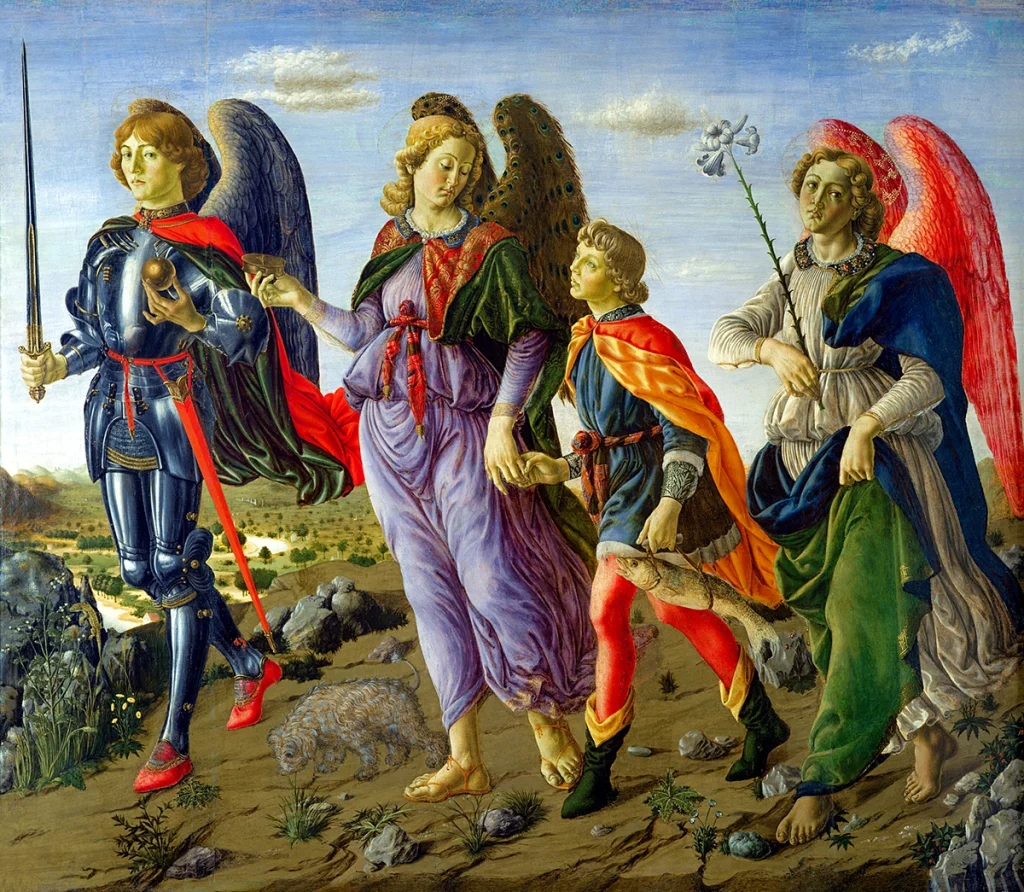
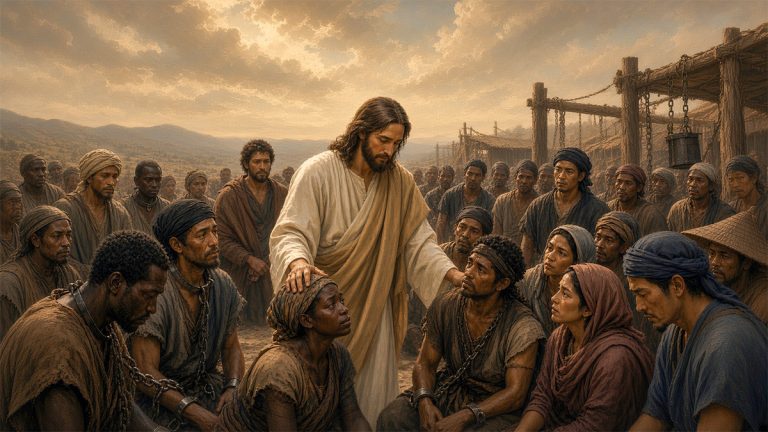
Every year, the Catholic Church recognizes September 29 as the Feast of Saints Michael, Gabriel, and Raphael, Archangels. For many Catholics today, this feast comes and goes without much fanfare, often handled as a minor date on the liturgical calendar. Its older English name, Michaelmas, is remembered, if it is remembered at all, as an old seasonal custom rather than the feast the Latin Church used to mark the transition into autumn. Modern Catholic culture tends to see devotion to Michael, Gabriel, and Raphael as more of a medieval tradition, useful for statues and private prayer but not integral to Catholic faith.
This was not always the case. The archangels are central to Catholic belief because Sacred Scripture names each of them and describes their work. Their office is to serve Christ and to lead souls to him. For that reason, the Church honored them from its earliest days. Later calendars, fast days, and national observances expanded on this devotion, institutionalizing what was already a long-standing Church tradition. For centuries, Michaelmas was a principal autumn feast day in the Catholic Church. The present calendar still keeps September 29 as the feast of Michael and the other archangels, but the older pattern of preparation, public honor, and ordinary Catholic practice around that day has faded considerably.
The Archangels in Scripture and in the Catechism
Catholic devotion to these three archangels did not arise out of thin air or popular superstition. It is rooted in Sacred Scripture.
Saint Michael the Archangel, Prince of the Heavenly Host
The name Michael comes from the ancient Hebrew, Mīkhāʾēl, or “Who is like God?” In Hebrew usage that question is not open-ended. It expects the answer “no one.” That is why Christian tradition treats the name as a battle cry against pride, especially against Lucifer’s desire to be like God.
In the Book of Daniel, Michael is named as the one who contends for Israel against opposing powers, namely the princes of Persia and Greece. (Daniel 10:13, 20) Later in the same book, he is identified as the great prince who stands for the people of God. “At that time shall arise Michael, the great prince who has charge of your people.” (Daniel 12:1) The Letter of Jude calls him “the Archangel” and recalls his dispute with the devil over the body of Moses. (Jude 9) The Book of Revelation describes his office in the war against the dragon: “Now war arose in heaven, Michael and his angels fighting against the dragon; and the dragon and his angels fought, but they were defeated and there was no longer any place for them in heaven. And the great dragon was thrown down, that ancient serpent, who is called the Devil and Satan, the deceiver of the whole world, he was thrown down to the earth, and his angels were thrown down with him.” (Revelation 12:7-9) Michael defends the people of God because God appointed him to that work.
Saint Gabriel the Archangel, Messenger of God
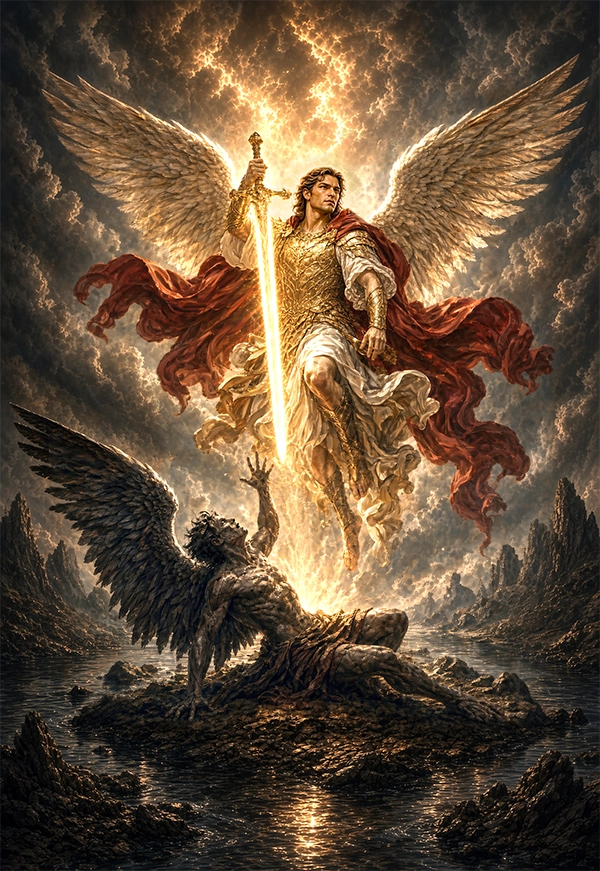
The name Gabriel comes from the ancient Hebrew, Gavrīʾēl, or “Strength of God.” In Daniel, he is sent to make visions intelligible. (Daniel 8:16; 9:21-23) In the Gospel of Luke, he stands before God and is sent first to Zechariah to announce the birth of John the Baptist, then to Mary to announce the Incarnation. His greeting to Mary is the beginning of the Hail Mary prayer: “Hail, full of grace, the Lord is with you!” (Luke 1:28) Gabriel does not speak on his own authority.
He faithfully carries the word of God. The central mystery of our faith, the taking of flesh by the Son, becomes known to the world through that announcement.
Saint Raphael the Archangel, Medicine of God and Companion of Travelers
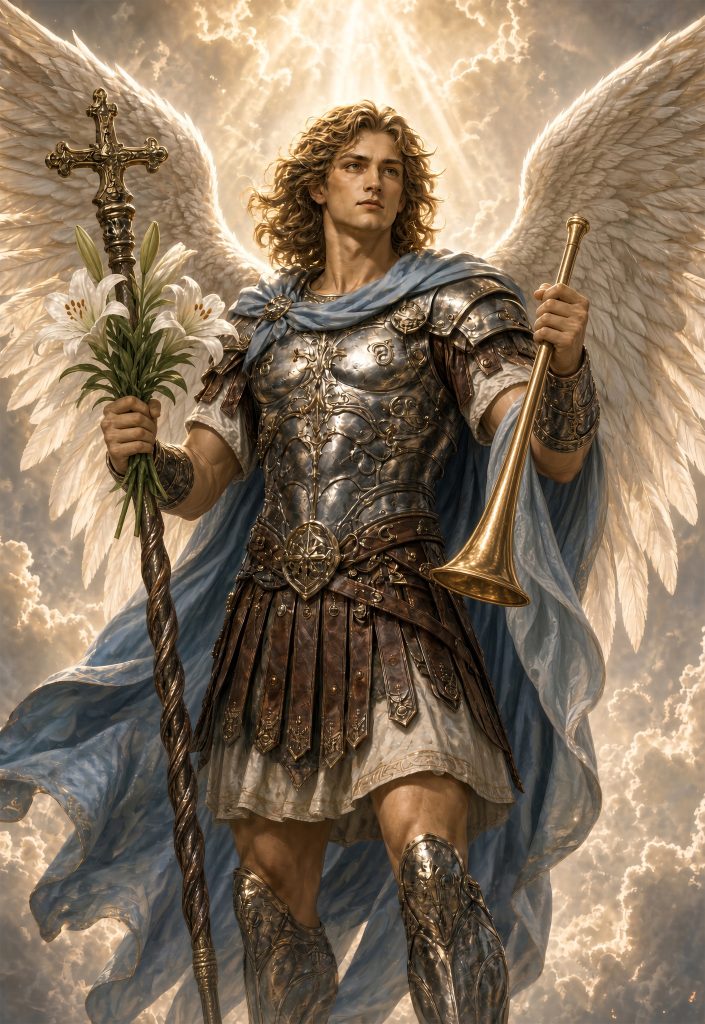
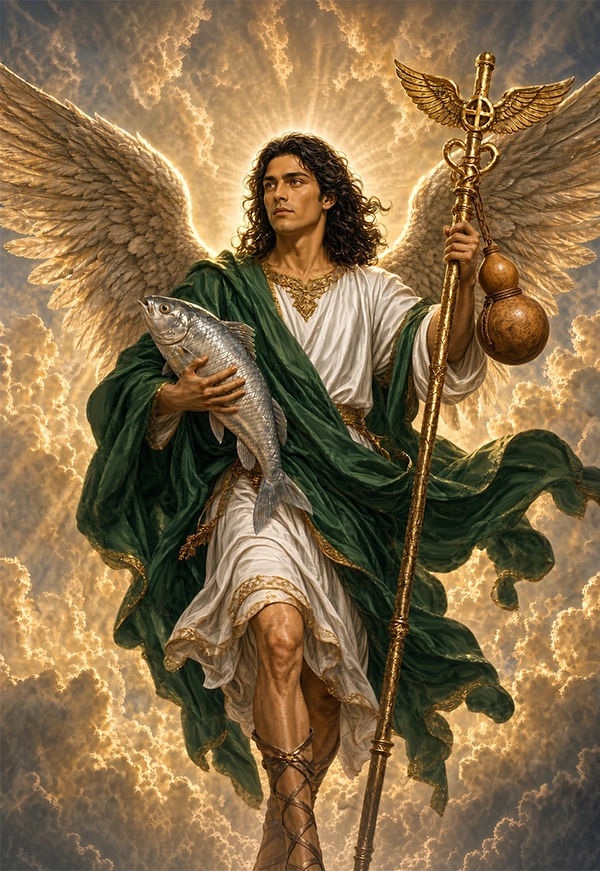
The name Raphael comes from the ancient Hebrew, Rəfāʾēl, or “God heals.” His story is told in the Book of Tobit. He accompanies Tobias on a long journey, helps him to catch a fish on the shore of the river Tigris, uses the fish’s heart and liver to drive a demon away from Sarah, and heals Tobit’s blindness with the fish’s gall. When the work is finished, he identifies himself: “I am Raphael, one of the seven holy angels who present the prayers of the saints and enter into the presence of the glory of the Lord.” (Tobit 12:15)
Two verses later, he states his role clearly: “Do not be afraid, you will be safe. But praise God for ever. For I did not come as a favor on my part, but by the will of our God. Therefore praise him for ever.” (Tobit 12:17-18)
The Catechism of the Catholic Church definitively states the doctrine surrounding angels. “The existence of the spiritual, non-corporeal beings whom Scripture calls angels is a truth of faith.” (CCC 328) “As purely spiritual creatures they have intelligence and will: they are personal and immortal creatures, surpassing in perfection all visible creatures, as the splendor of their glory bears witness.” (CCC 330) “Christ is the center of the angelic world. They are his angels: ‘When the Son of man comes in his glory, and all the angels with him.’ They belong to him because they were created through and for him…” (CCC 331) “In her liturgy, the Church joins with the angels to adore the thrice-holy God. She invokes their assistance […], she celebrates the memory of certain angels more particularly (St. Michael, St. Gabriel, St. Raphael, and the guardian angels).” (CCC 335)
The archangels are venerated because they stand as noble examples of humility and service to the authority of the Father, the Son, and the Holy Spirit. Their power and position come from their total willingness to serve Christ with their whole being. They always point to heaven and never seek to be glorified as ends in themselves.
Devotion to the Archangels
The veneration of angels dates back to the time of the Apostles, as evidenced in Luke, Jude, and Revelation. These texts point to them as heralds, protectors, and defenders of God’s almighty authority, who faithfully execute his will across the ages.
In fact, early devotion to the angels was so strong that the fourth-century Council of Laodicea had to correct Christians in Asia Minor on their proper place in the divine hierarchy. Canon 35 from the council states: “Christians must not forsake the Church of God, and go away and invoke angels and gather assemblies, which things are forbidden. If, therefore, any one shall be found engaged in this covert idolatry, let him be anathema; for he has forsaken our Lord Jesus Christ, the Son of God, and has gone over to idolatry.” In other words, Christians may not leave the Church of God to invoke angels in a private rite, as if the angels were mediators in place of the Son. The angels serve Jesus Christ, who with the Father and the Holy Spirit is the one God.

Churches dedicated to Saint Michael are already attested in the Christian East in the fourth century. Just north of Constantinople, the Michaelion stood as a popular pilgrimage site for nearly a thousand years. Sozomen, writing in the fifth century, describes the crowds and miraculous healings reported there, including one he says he received himself. Coptic Egypt developed a marked devotion to Michael, including commemoration of the archangel in the monthly cycle of their calendar.
In the sixth century, Saint Gregory the Great elaborated on the roles of the archangels in his Homiliae in Evangelia (34.8–9), where he states: “Those who announce lesser things are called angels; those who announce the highest things are called archangels. That is why not just any angel, but the archangel Gabriel, is sent to the Virgin Mary. It was fitting that the highest angel should come for this ministry, since he was announcing the highest of all tidings. The names of the individual angels also mark what they do. Michael means ‘Who is like God?’; Gabriel, ‘Strength of God’; Raphael, ‘Medicine of God’.”
“And whenever something of wondrous power is done, Michael is said to be sent, so that from the act itself and from the name it may be understood that no one can do what God is able to do. Hence that ancient enemy who is pride desired to be like God, saying: ‘I will ascend into heaven, I will exalt my throne above the stars of heaven, I will sit on the mount of the covenant in the sides of the north, I will ascend above the height of the clouds, I will be like the Most High,’ (Isaiah 14:13-14) is shown at the end of the world, left to his own strength and about to be destroyed in the last punishment, as destined to fight with the archangel Michael.”
Origin of the September 29 Feast
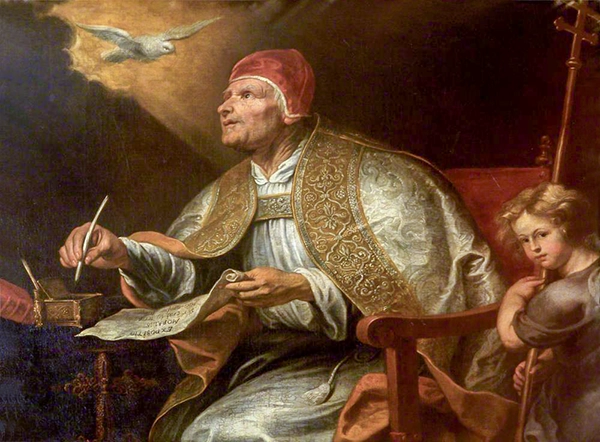
The date of the feast originated in Rome. It commemorates the dedication of the Basilica of Saint Michael on the Via Salaria, about six or seven miles north of the Eternal City. The Gelasian Sacramentary, a seventh-century Roman book of Mass prayers, already lists a feast of Saint Michael the Archangel on September 29. The Gregorian Sacramentary, a century later, calls it the Dedication of the Basilica of Saint Michael the Archangel, and some manuscripts add “via Salaria.” Some later writers associate the basilica’s consecration with Pope Boniface II around the year 530. The church itself disappeared by about the ninth or tenth century, but the liturgical title remained “the Dedication of Saint Michael the Archangel” for more than a thousand years.
Saint Michael’s Lent
The importance of September 29, or Michaelmas, is also visible in the way Catholics traditionally prepared for it.
The devotion known as Saint Michael’s Lent runs from the Solemnity of the Assumption on August 15 to the feast of Saint Michael on September 29. Sundays are excluded from the count of fast days, as they are in the Lent before Easter, so the period is kept as forty days. The devotion honors the Blessed Virgin and Saint Michael together, since both direct the faithful to Christ.

Saint Francis of Assisi observed this fast. In his Life of Saint Francis, Saint Bonaventure writes that Francis went to Mount La Verna in order to keep a Lent in honor of Saint Michael the Archangel. The Little Flowers of Saint Francis records Francis telling his brothers that they were drawing near to the forty days’ fast of Saint Michael, and that he believed it was the will of God that they keep the fast on that mountain. During the fast of 1224, near the Feast of the Exaltation of the Holy Cross, Francis received the stigmata.
A shorter form of preparation is older than the custom practiced by the Franciscans. The laws of King Ethelred of England, issued in 1014, required every Christian of age to fast three days on bread, water, and raw herbs before the Feast of Saint Michael, go to confession, take part in barefoot processions, and give to the poor the food that would otherwise have been eaten. Servants were to be released from labor on those days so that they could keep the fast.
Saint Michael’s Lent is a pious custom, not a universal precept of the same kind as the Lent before Easter. However, it remains as useful evidence that saints and Christian rulers prepared for Michaelmas with fasting because they regarded the feast as a day that deserved that level of seriousness.
Michaelmas in the Liturgical Year
The place of the feast in the year is part of its meaning. September 29 falls at the end of harvest in much of Western Europe and at the beginning of the darker half of the year. When field work ended and the days grew shorter and colder, the Church celebrated a feast devoted to the protector of God’s people. Michaelmas is the autumn marker by which the traditional liturgical calendar taught Catholics to close the productive season and enter under the protection of the archangel who reminds us to be humble before God.
Join the Order
For readers who want more than the novels: the history that shaped the Order, notes from the author, and first word on new books and bonus material before it goes public.
One email a month. Unsubscribe anytime.

Michaelmas Observance Across Western Europe
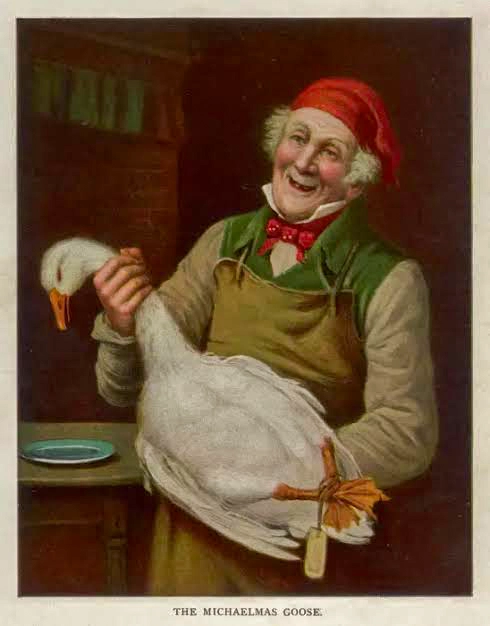
In England, Wales, and Ireland, Michaelmas was a holy day of obligation throughout the Middle Ages. It was also one of the four Quarter Days, together with Lady Day (March 25), Saint John’s Day (June 24), and Christmas (December 25). These were the days on which rents were paid, leases began or ended, accounts were settled, and farm servants were hired. The Michaelmas goose comes from that rural economy. After the grain was cut, geese were turned onto the stubble fields to fatten.
In Ireland, the season was called Fómhar na nGéanna, the goose harvest. Cuid Mhichíl, “Michael’s share,” referred to killing an animal and giving portions of meat to the poor.
Italy marks the feast with processions, when towns dedicated to Saint Michael carry statues of the archangel with his sword piercing the dragon. The procession is an act of petition and public remembrance, asking the defender of the Church to pray for those who follow Christ. The cave at Monte Gargano, where Saint Michael is said to have appeared in 490 to 493, remains the center of Italian pilgrimage.
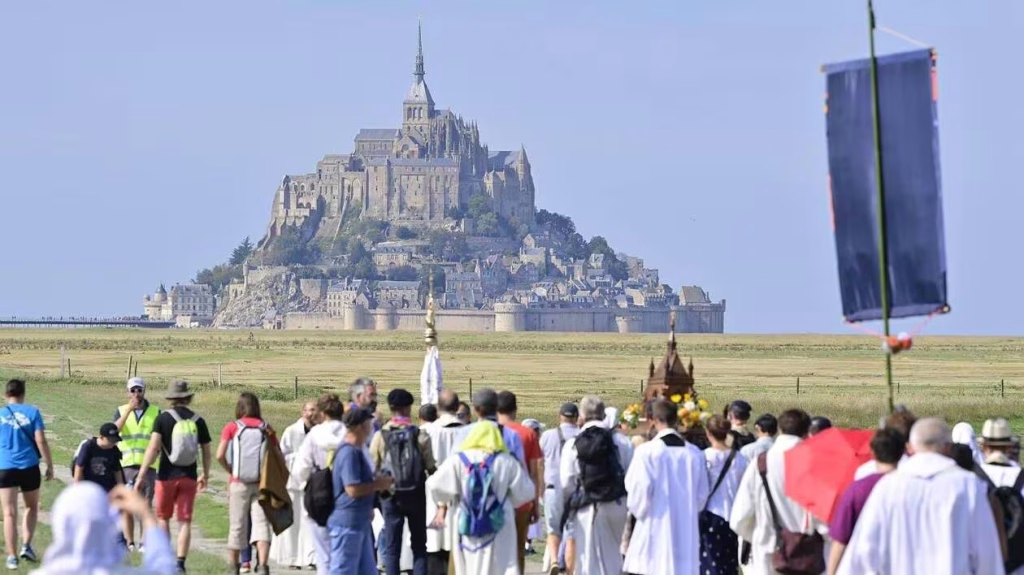
In France, the great center is Mont-Saint-Michel. The abbey was dedicated in October 709, in deliberate relation to Monte Gargano. Messengers were sent to Gargano for relics so that the new sanctuary would be joined to the Italian one. The Norman abbey became one of the major pilgrimage churches of northern Europe. Throughout the medieval period, pilgrims crossed the bay to the mount at low tide to honor the Prince of the Heavenly Host.
The Synod of Mainz in 813 spread the September 29 feast throughout the Carolingian lands as a public holiday. Charlemagne treated it as a holy day of obligation. In the later Middle Ages, Saint Michael was invoked as a patron of the German Empire. Across German-speaking regions, people read the coming winter from the breastbone of the Michaelmas goose. German immigrants carried that custom to America, where it survived among the Pennsylvania Dutch.
Spain already marked the feast in Visigothic and Mozarabic calendars. The observance is therefore present in the old Hispanic rite, not only in the Roman calendar that arrived later. Early Spanish churches bear the archangel’s name. The monastery church of San Miguel de Escalada in León was rebuilt in the tenth century by monks who had come from Córdoba. In Navarre, the sanctuary of San Miguel de Aralar has been a mountain pilgrimage site for centuries. The image of the archangel is still carried through a large number of towns to bless the fields and visit the sick. The feast on September 29 closed the summer ascents to the sanctuary.
Portugal names Saint Michael the Archangel as guardian of the realm in its own tradition. Towns across the country celebrated autumn fairs of São Miguel in the days around September 29. Later Portuguese chroniclers connected the Order of Saint Michael of the Wing with Afonso Henriques, claiming that the archangel’s aid was seen in the campaign for Santarém.

Local rites and dates differed, but the underlying theme did not. The whole of Christendom recognized the archangels as servants of Christ whose names were worthy of a major liturgical holiday.
Changes in the Modern Calendar
In 1921, Pope Benedict XV gave Gabriel a universal feast on March 24 (the eve of the Annunciation) and Raphael a feast on October 24. In 1969-70, under Paul VI’s Mysterii Paschalis, Gabriel’s and Raphael’s separate days were suppressed and both names were added to September 29. The former title, Dedication of Saint Michael the Archangel, was changed to the Feast of Saints Michael, Gabriel, and Raphael, Archangels. The older Divine Office for September 29 already named Gabriel and Raphael in its hymns, even when the title of the day referred only to Saint Michael’s dedication.
September 29 is still a feast of the three archangels. The celebration remains valid, but the difficulty is that modern Catholic practice often treats the day as a notice on the calendar rather than as the solemn autumn feast it was for most of Latin Catholic history.
Recovering the Practice
Michael, Gabriel, and Raphael belong to Catholic faith because God made them known in Scripture and because the Church has honored them in her public prayer from the earliest centuries. In their own way, each of them points us to Jesus Christ. Saint Gabriel announces the Incarnation. Saint Raphael heals and accompanies those on their journey toward God. Saint Michael defends the Church that Christ founded.
Faithful Roman Catholics need to recover the traditional practice that once surrounded the day. Those who can keep Saint Michael’s Lent should keep it. Children should be taught the three archangels’ names and the missions given to them in Scripture. The feast itself should be kept as a feast: going to Mass, receiving the Eucharist, and asking the Prince of the Heavenly Host to guard the Church.
The present neglect of the archangels is not required by Catholic doctrine. It is a symptom of our modern forgetfulness. The Church has never taught us to ignore the servants whom Christ sends. She has always taught us that they point to him, and that we are to live our lives in accordance with that truth.
Saints Michael, Gabriel, and Raphael, Archangels, pray for us!